When a flange leak occurs on an offshore platform 80 kilometers into the Arabian Gulf, every minute counts. Production stops. Revenue evaporates at millions of dirhams per day. Your team scrambles to fix the problem in harsh conditions where a single mistake could trigger catastrophic consequences.
This isn’t a hypothetical scenario. It’s reality for UAE offshore operators managing critical bolted connections in some of the world’s most challenging environments.
If you’re responsible for offshore maintenance, turnaround operations, or emergency response in UAE’s oil and gas sector, you already know that proper bolting isn’t just about following procedures—it’s about protecting lives, assets, and the environment while keeping operations running.
This guide cuts through the technical jargon to answer the practical questions you face: What hydraulic torque tools actually work in offshore conditions? How do you meet ATEX requirements? What separates equipment that performs from equipment that fails when you need it most?
Let’s dive into what matters for your offshore operations.
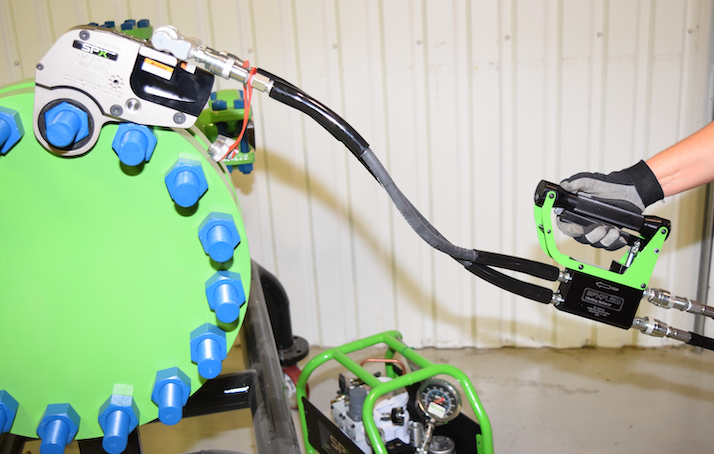
Why Standard Tools Fail Offshore (And What You Actually Need)
The Offshore Reality Check
Working on UAE offshore platforms means dealing with conditions that destroy standard equipment:
Environmental Assault Your tools face constant salt spray, temperatures swinging from 15°C at night to 55°C in direct sun, humidity above 90%, sandstorms that penetrate everything, and UV radiation that degrades materials faster than you’d expect.
Operational Demands You’re working with high-pressure systems up to 15,000 psi, flammable materials where sparks mean disaster, remote locations where help is hours away, and zero tolerance for leaks or failures.
The Cost of Getting It Wrong A single bolting failure offshore can result in fires or explosions, environmental disasters, production shutdowns costing millions daily, injuries or fatalities, and regulatory sanctions that impact your license to operate.
This is why choosing hydraulic torque tools for offshore work demands more than checking a spec sheet and ordering the cheapest option.
What Makes Hydraulic Tools Essential Offshore
Consistency When It Matters Most
Manual torque wrenches depend on operator strength and technique. At 3 AM during a critical repair with rough seas and a looming weather window, that variability becomes dangerous. Hydraulic torque wrenches deliver precise, repeatable torque regardless of who’s operating them or what conditions they’re facing.
Power for Real-World Applications
Offshore platforms use massive bolts that manual tools simply cannot handle. Those 36-inch pipeline flanges? The pressure vessel closures? The wellhead connections? They require torque values from 30,000 Nm up to 150,000 Nm. You need hydraulic power to get the job done.
Safety in Explosive Atmospheres
ATEX-certified hydraulic torque tools eliminate spark risks in areas where hydrocarbon vapors could ignite. This isn’t optional—it’s mandated by regulations and your company’s survival instincts.
Protecting Your Team
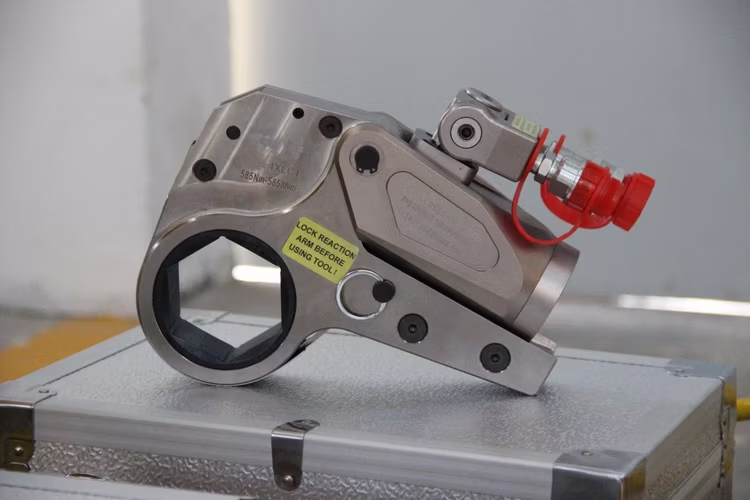
Reaction arms eliminate dangerous kickback that can injure operators. Your crew isn’t fighting against massive torque forces, which reduces injuries and fatigue during the extended maintenance operations that are routine offshore.
Critical Applications: Where You’ll Use These Tools
Flange Management
Your platform contains hundreds of flanged connections in critical services. Each one must maintain perfect sealing under extreme pressures and temperatures.
You’re dealing with:
- Process piping flanges from 6 to 48 inches
- Wellhead connections that can’t leak
- Heat exchanger connections operating at temperature extremes
- Compressor and pump flanges under constant vibration
Torque Requirements Breakdown:
- Small bore (2″-6″): 500-5,000 Nm
- Medium bore (8″-16″): 5,000-25,000 Nm
- Large bore (18″-48″): 25,000-100,000+ Nm
The critical part? Flange bolting requires specific patterns and sequences to ensure even gasket compression. Random tightening creates uneven loading, gasket failure, and leaks. Hydraulic torque tools with programmable sequences ensure proper load distribution every time.
Subsea Equipment Maintenance
Christmas trees, manifolds, and pipeline terminations require periodic maintenance that often happens on deck after equipment retrieval.
The Challenge: Bolts exposed to seawater for months or years develop severe corrosion. You need high breakaway torque to remove them without breaking fasteners. Once removed, reassembly requires precision to maintain pressure boundaries.
What Works: Subsea-rated hydraulic torque tools with corrosion-resistant materials, high torque capacity for seized connections, and low-profile designs for the restricted access that’s standard with subsea equipment.
Turbine and Rotating Equipment
Gas turbines, compressors, and pumps are the heartbeat of your platform. Their bolted connections require precision to maintain alignment and prevent vibration failures.
These applications demand torque accuracy within ±3% to prevent misalignment that leads to vibration, premature bearing failure, and unplanned shutdowns. Digital hydraulic torque tools with current calibration aren’t luxuries—they’re necessities.
Pressure Vessel Closures
Separators, scrubbers, and storage vessels have critical bolted closures that must withstand internal pressures while allowing periodic inspection access.
Manway closures typically require 10,000-30,000 Nm. Vessel head bolts often need 30,000-80,000 Nm. Improper torque on these closures can result in catastrophic failures during operation. There’s no room for approximation.
Selecting Tools That Actually Perform
The Specifications That Matter
Torque Range Coverage
Map your facility’s bolt sizes and materials to determine what you need. But don’t stop there. Account for corroded or seized bolts requiring 2-3 times normal torque, future expansion requirements, and emergency situations where you need flexibility.
A typical offshore inventory includes:
- 1,000-5,000 Nm for small flanges and instrument connections
- 10,000-30,000 Nm for standard process flanges
- 40,000-80,000 Nm for large bore and vessel closures
- 100,000+ Nm for specialized heavy-duty applications
Hazardous Area Certification You Can Trust
For UAE offshore operations, you need ATEX certification meeting European standards, IECEx certification for international recognition, and specific Zone ratings matching your work areas.
Most offshore bolting happens in Zone 1 areas where explosive atmospheres are likely during normal operations. Your tools need Category 2G certification minimum. Don’t compromise here—regulators won’t, and neither should you.
Environmental Protection
Look for IP67 or IP68 ratings for water and dust ingress protection, corrosion-resistant materials like stainless steel with special coatings, sealed electronics and connections, UV-resistant components, and operating temperature ranges from -10°C to +60°C minimum.
If the manufacturer can’t document how their tools handle Arabian Gulf conditions, keep looking.
Power Source Decisions
Hydraulic Power (The Standard)
Electric hydraulic pumps work well for platform-based operations. Pneumatic pumps integrate with existing compressed air systems. Battery-powered pumps offer portability without air or electric requirements. Manual pumps provide emergency backup when nothing else works.
Advantages: High power across full torque range, proven reliability, widest tool selection. Drawbacks: Requires pumps and hoses, potential hydraulic fluid leaks in marine environment.
Battery Electric (Growing Fast)
Self-contained power eliminates hoses and external pumps. Cleaner operation matters in environmentally sensitive areas. Currently limited to lower torque ranges (typically under 10,000 Nm), but technology is improving rapidly.
For smaller flanges and instrument work, battery tools now offer compelling advantages in offshore environments.
Procedures That Prevent Failures
Before You Start: Planning That Saves Lives
Every offshore bolting job needs a Job Safety Analysis identifying hazards, required permits, communication protocols, and emergency procedures.
Develop proper bolting procedures calculating required torque based on bolt material and grade, flange rating and material, gasket type and service conditions, installation temperature versus operating temperature, and lubricant coefficient of friction.
Verify your equipment has current calibration (typically valid 6-12 months), inspect tools for damage, test pump operation and pressure accuracy, verify socket condition and proper fit, and check hoses for deterioration.
Tightening Sequences That Work
Incorrect sequences cause uneven gasket compression, leading to leaks and failures.
Standard Patterns:
- 4-bolt flanges: Cross pattern (1-3-2-4)
- 8-bolt flanges: Star pattern starting opposite centerline
- Large flanges (16+ bolts): Quadrant method dividing into quarters, working from center outward
Multi-Pass Progressive Tightening
Professional offshore bolting uses multiple passes:
Pass 1 at 30% of final torque ensures all bolts are seated, identifies misalignment early, and allows gasket to begin compressing evenly.
Pass 2 at 60% of final torque provides progressive loading that prevents gasket damage and allows stress redistribution.
Pass 3 at 100% achieves your target torque specification.
Verification pass returns to the first bolt, checks for relaxation, confirms all bolts maintain target, and documents final values.
This takes more time than single-pass tightening, but it prevents the leaks that cost millions in lost production.
Documentation You Actually Need
Offshore operations require records that satisfy regulators, clients, and your own quality systems:
Tool calibration certificates current and traceable to international standards, bolting records showing joint identification, specified versus achieved torque values, tightening sequence used, number of passes completed, operator identification, date and time, and any anomalies encountered.
Modern digital hydraulic torque tools automate this documentation, eliminating manual recording errors and providing instant proof of proper procedures for audits and investigations.
Meeting ATEX and Safety Requirements
Understanding ATEX for Your Operations
ATEX zones on offshore platforms break down as:
Zone 1: Explosive atmosphere likely during normal operations. This includes areas around process equipment and piping, inside modules with hydrocarbon handling, near vents and relief valves. Most flange bolting operations occur in Zone 1.
Zone 2: Explosive atmosphere unlikely during normal operations. This covers utility areas, some structural locations, and administrative spaces.
For Zone 1 work, you need Category 2G equipment. The certification marking tells you what you need to know:
II 2G Ex h IIC T4 GbThis means: Equipment suitable for surface industries (II), Category 2 for gas atmospheres (2G), explosion protection by encapsulation (Ex h), suitable for hydrogen environments—most stringent (IIC), maximum surface temperature 135°C (T4), and Equipment Protection Level Gb for Zone 1.
Don’t buy tools without understanding what these markings mean for your specific applications.
Compliance Standards That Matter
API RP 6A covers wellhead and Christmas tree equipment with specific bolting requirements.
ASME PCC-1 provides comprehensive bolting best practices widely referenced as the industry standard for pressure boundary flange assembly.
ADNOC HSE Standards (for Abu Dhabi operations) include specific bolting procedure approval processes and competency requirements for bolting technicians.
Major international operators (Shell, BP, Total) often have internal standards exceeding regulatory minimums. Always verify specific client requirements before mobilizing offshore.
Maintenance and Calibration Reality
Keeping Tools Reliable
Offshore environments accelerate wear. Your maintenance schedule should include:
Daily during active use: Visual inspection, clean external surfaces, check hydraulic fluid levels, test operation with no load.
Weekly: Detailed component inspection, lubricate moving parts, check reaction arm condition, inspect sockets for wear or cracking.
Monthly: Replace hydraulic filters, check fastener tightness, inspect electrical components, function test safety features.
Annually: Complete rebuild or manufacturer service, replace all seals and wear items, full calibration verification, load test at maximum capacity.
Calibration You Can Defend
Industry standards require calibration every 6 months for harsh offshore environments, every 12 months for controlled environments, after any drop or impact, after major repairs, and when accuracy is questionable.
Proper calibration must be traceable to national standards (NIST, NPL, etc.), performed by accredited laboratories (ISO 17025), and documented with certificates showing “as found” condition, “as left” accuracy, points tested across working range, and uncertainty of measurement.
Most offshore operations require accuracy within ±3% of applied torque, with repeatability within ±2%.
Between formal calibrations, perform field verification using calibrated torque transducers or comparative testing against known-good tools. Document everything.
Real-World Success: What Actually Works
Emergency Flange Repair Case
A major producer experienced a 24-inch crude oil export line flange leak 80km offshore. Platform shutdown cost approximately $2 million per day. Standard equipment couldn’t access the flange due to congested piping.
The solution required a low-profile 40,000 Nm hydraulic torque wrench with extended reaction arms, mobilized within 6 hours with an experienced bolting supervisor.
Result: Flange successfully re-torqued in 22 hours, platform returned to production ahead of schedule, zero safety incidents, complete regulatory documentation, and approximately $3.8 million saved in avoided downtime.
The key? Having the right tool available immediately, not the cheapest tool available eventually.
Turnaround Maintenance Campaign
A five-week turnaround required working on over 300 flanges (4″ to 36″ diameter) simultaneously across multiple process units.
Rather than purchasing equipment for a short-term project, the contractor used a comprehensive rental package: 8 hydraulic torque wrenches (1,000-60,000 Nm range), 4 dual-outlet electric pumps, 2 pneumatic pumps for air-powered zones, complete socket inventory, and digital documentation system.
Result: All flanges completed on schedule, zero leaks at restart, complete torque records, rental cost 60% less than purchasing, and no ongoing ownership costs after project completion.
Smart project economics aligned equipment costs with actual needs rather than ideal inventory wishes.
Choosing Your Offshore Partner
What Separates Suppliers Who Deliver from Suppliers Who Disappoint
Local Response Speed
When you have a critical issue offshore, international suppliers shipping from Europe or America can’t help you. You need partners based in UAE who can mobilize equipment within hours, not days or weeks.
Technical Competence
Sales representatives who read spec sheets aren’t enough. You need engineers who’ve actually worked offshore, understand your applications, can develop proper bolting procedures, and troubleshoot problems remotely when your team is on the platform.
Complete Solutions
Equipment without accessories, calibration services, documentation support, and training creates gaps that fail during critical operations. Look for suppliers providing integrated solutions, not just catalog items.
Inventory Depth
Suppliers promising anything but stocking nothing leave you waiting when emergencies arise. Substantial local inventory in Dubai or Abu Dhabi ensures you get what you need when you need it.
Pluz Group’s Offshore Advantage
We’ve built our reputation supporting UAE offshore operations with equipment that performs, service that responds, and expertise that solves problems.
Our Capabilities Include:
Comprehensive ATEX-certified tool inventory from 100 Nm to 100,000+ Nm, emergency equipment rental with 24/7 availability and helicopter-compatible packaging, on-site calibration services with ISO 17025 traceability, technical support including procedure development and operator training, and competitive pricing that’s 15-25% below premium international brands without compromising quality.
Why Offshore Operators Choose Us:
We’re based in Dubai with extensive Arabian Gulf experience. Our response times are measured in hours, not days. We maintain substantial local stock eliminating international shipping delays. Our engineers have decades of combined offshore experience across UAE operations.
Most importantly, we understand that your success is our success. When you call with an emergency, we mobilize. When you need technical guidance, we provide it. When you require documentation for audits, we deliver it.
Making Your Decision
Selecting hydraulic torque tools for offshore operations isn’t about finding the cheapest option or the fanciest brand. It’s about choosing equipment and partners that ensure your critical bolted connections remain secure when lives and assets depend on them.
Ask yourself these questions:
Does this equipment meet ATEX requirements for my work areas? Can this supplier mobilize equipment within hours for emergencies? Do they maintain calibration services in UAE? Have they actually supported offshore operations in Arabian Gulf conditions? Can they provide technical support beyond just selling tools?
If you can’t answer yes to all these questions, keep looking.
Ready to Ensure Your Offshore Bolting Success?
Contact Pluz Group today for:
- Free technical consultation on your offshore requirements
- Equipment demonstrations and application testing
- Competitive rental and purchase quotations
- Emergency equipment mobilization
- Calibration services and certification
- Operator training and procedure development
Our Dubai team is ready to support your offshore operations with equipment, expertise, and service that delivers results when it matters most.
Don’t wait until an emergency exposes gaps in your bolting capabilities. Let’s discuss your requirements now and ensure you have the tools, procedures, and support needed for safe, reliable offshore operations.
Call us today or visit our facility to see the difference that proper offshore bolting solutions make.