When a flange leak occurs on an offshore platform 80 kilometres into the Arabian Gulf, every minute counts. Production stops. Revenue disappears at millions of dirhams per day. Your team scrambles to fix the problem in harsh conditions where a single mistake could trigger serious consequences.
This is not a hypothetical scenario. In fact, it is reality for UAE offshore operators managing critical bolted connections in some of the world’s most demanding environments.
If you are responsible for offshore maintenance, turnaround operations, or emergency response in UAE’s oil and gas sector, you already know that proper bolting is not just about following procedures — it is about protecting lives, assets, and the environment while keeping operations running.
This guide answers the practical questions you face: which hydraulic torque tools UAE offshore teams actually need, how to meet ATEX requirements, and what separates equipment that performs from equipment that fails when you need it most.
Why Standard Tools Fail Offshore
The Offshore Reality
Working on UAE offshore platforms means dealing with conditions that damage or destroy standard equipment fast.
Environmental challenges:
- Constant salt spray and humidity above 90% in coastal zones
- Temperatures swinging from 15°C at night to 55°C in direct sun
- Sandstorms that penetrate every unsealed component
- UV radiation that degrades materials faster than most buyers expect
Operational demands:
- High-pressure systems up to 15,000 psi
- Flammable materials where a single spark means disaster
- Remote locations where help is hours away
- Zero tolerance for leaks or equipment failures
The Cost of Getting It Wrong
A single bolting failure offshore can trigger fires or explosions, environmental damage, production shutdowns costing millions per day, serious injuries, and regulatory sanctions that affect your licence to operate. Because of this, choosing the right hydraulic torque tools for UAE offshore work demands far more than checking a spec sheet.
What Makes Hydraulic Torque Tools Essential Offshore
Consistency When It Matters Most
Manual torque wrenches depend on the operator’s strength and technique. At 3 AM during a critical repair — with rough seas and a closing weather window — that variability becomes dangerous. Hydraulic torque wrenches, by contrast, deliver precise, repeatable torque regardless of who operates them or what conditions they face.
Power for Real-World Applications
Offshore platforms use massive bolts that manual tools simply cannot handle. Those 36-inch pipeline flanges, pressure vessel closures, and wellhead connections require torque values from 30,000 Nm up to 150,000 Nm. Consequently, hydraulic power is the only practical solution for this work.
Safety in Explosive Atmospheres
ATEX-certified hydraulic torque tools remove spark risks in areas where hydrocarbon vapours could ignite. Crucially, this is not optional — regulations require it, and your team’s safety demands it.
Protecting Your Team
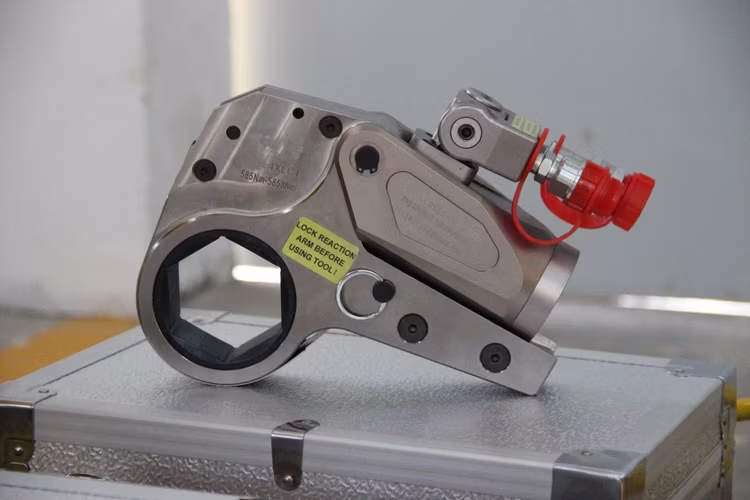
Reaction arms remove the dangerous kickback that injures operators. Instead of fighting against massive torque forces, your crew works safely and without excessive fatigue — even during the extended maintenance operations that are routine in offshore environments.
Critical Applications: Where You Will Use These Tools
Flange Management
Your platform holds hundreds of flanged connections in critical service lines. Each one must maintain a perfect seal under extreme pressures and temperatures.
Typical flange sizes and torque requirements:
| Flange Size | Torque Range |
|---|---|
| Small bore (2–6 inch) | 500–5,000 Nm |
| Medium bore (8–16 inch) | 5,000–25,000 Nm |
| Large bore (18–48 inch) | 25,000–100,000+ Nm |
Flange bolting also requires specific tightening patterns and sequences to ensure even gasket compression. Without these, random tightening creates uneven loading, gasket failure, and leaks. Fortunately, hydraulic torque tools with programmable sequences ensure proper load distribution on every joint.
Subsea Equipment Maintenance
Christmas trees, manifolds, and pipeline terminations need periodic maintenance — often on deck after retrieval from the seabed. Bolts exposed to seawater for months or years develop severe corrosion. Therefore, you need high breakaway torque to free them without snapping fasteners.
Once removed, reassembly requires precision to maintain pressure boundaries. The right tool here is a subsea-rated hydraulic torque wrench with corrosion-resistant materials, high torque capacity, and a low-profile design suited to restricted access.
Turbine and Rotating Equipment
Gas turbines, compressors, and pumps are the core of your platform. Their bolted connections need precision to maintain alignment and prevent vibration failures. In particular, these applications demand torque accuracy within ±3%. As a result, digital hydraulic torque tools with current calibration are not a luxury here — they are a necessity.
Pressure Vessel Closures
Separators, scrubbers, and storage vessels have critical bolted closures that must hold internal pressure while allowing periodic inspection access. For example, manway closures typically require 10,000–30,000 Nm, while vessel head bolts often need 30,000–80,000 Nm. Clearly, there is no room for guesswork on these joints.
Selecting Hydraulic Torque Tools UAE Offshore Teams Can Trust
Torque Range Coverage
Start by mapping your facility’s bolt sizes and materials. However, do not stop there. Account for corroded or seized bolts that may require two to three times the normal torque, future expansion requirements, and emergency situations where flexibility is critical.
A typical offshore tool inventory covers:
- 1,000–5,000 Nm for small flanges and instrument connections
- 10,000–30,000 Nm for standard process flanges
- 40,000–80,000 Nm for large bore and vessel closures
- 100,000+ Nm for specialised heavy-duty applications
Hazardous Area Certification
For UAE offshore operations, you need ATEX certification meeting European standards, IECEx certification for international recognition, and zone ratings that match your specific work areas. Most offshore bolting takes place in Zone 1, where explosive atmospheres are likely during normal operations. Your tools need Category 2G certification as a minimum. Furthermore, do not accept verbal assurances — request the certification documents and verify them.
How to read an ATEX marking:
II 2G Ex h IIC T4 Gb means: surface industry equipment (II), Category 2 for gas atmospheres (2G), explosion protection by encapsulation (Ex h), rated for hydrogen environments — the most demanding gas group (IIC), maximum surface temperature of 135°C (T4), and Equipment Protection Level Gb for Zone 1 work.
Understanding this marking helps you verify that the tools you purchase actually match your work areas.
Environmental Protection Ratings
Look for IP67 or IP68 ratings for water and dust protection, corrosion-resistant materials with specialist coatings, sealed electronics and connectors, UV-resistant components, and an operating temperature range of at least -10°C to +60°C. If the manufacturer cannot document how their tools handle Arabian Gulf conditions, look elsewhere.
Power Source Options
Hydraulic power remains the standard for platform-based work. Electric hydraulic pumps, pneumatic pumps, battery-powered pumps, and manual backup pumps all have their place. The main advantage is high, consistent power across the full torque range. The main consideration is that hydraulic systems require hoses and pumps, and fluid leaks need careful management in a marine environment.
Battery electric tools are growing in popularity, particularly for smaller flanges and instrument work. They eliminate hoses and external pumps, offer cleaner operation, and suit environmentally sensitive areas. Currently, most battery tools perform best below 10,000 Nm — though this range is improving steadily as battery technology advances.
🔗 For current ATEX certification standards and zone classification guidance, refer to the European ATEX Directive 2014/34/EU and the IECEx International Certification System.
Bolting Procedures That Prevent Failures
Planning Before You Start
Every offshore bolting job needs a Job Safety Analysis covering identified hazards, required work permits, communication protocols, and emergency procedures. Additionally, develop a bolting procedure that calculates the required torque based on bolt material and grade, flange rating and material, gasket type and service conditions, installation versus operating temperature, and lubricant friction values.
Before mobilising to the job, verify that all equipment has current calibration, inspect tools for visible damage, test pump operation and pressure accuracy, confirm socket condition and proper fit, and check hoses for signs of wear or deterioration.
Tightening Sequences That Work
Incorrect sequences cause uneven gasket compression, which leads directly to leaks and failures. Use proven patterns for every flange size:
- 4-bolt flanges — Cross pattern: 1-3-2-4
- 8-bolt flanges — Star pattern, starting opposite the centreline
- Large flanges (16+ bolts) — Quadrant method: divide into quarters, work from centre outward
Multi-Pass Progressive Tightening
Professional offshore bolting uses multiple tightening passes rather than a single full-torque pass.
Pass 1 — 30% of final torque: Seats all bolts, identifies misalignment early, and allows the gasket to begin compressing evenly.
Pass 2 — 60% of final torque: Provides progressive loading that prevents gasket damage and allows stress to redistribute across the joint.
Pass 3 — 100% of final torque: Reaches your target specification with the gasket correctly loaded throughout.
Verification pass: Returns to the first bolt, checks for relaxation, confirms all bolts hold target torque, and records final values.
This process takes longer than single-pass tightening. However, it prevents the leaks that shut down production and cost millions in lost output.
Documentation You Need to Keep
Offshore operations require bolting records that satisfy regulators, clients, and your own quality systems. At a minimum, records should include tool calibration certificates, joint identification, specified versus achieved torque values, tightening sequence used, number of passes completed, operator name, date and time, and any problems encountered.
Modern digital hydraulic torque tools automate this documentation. As a result, they eliminate manual recording errors and provide instant proof of correct procedures for audits and investigations.
Meeting ATEX and Safety Standards
Compliance Standards That Apply
API RP 6A covers wellhead and Christmas tree equipment with specific bolting requirements relevant to UAE offshore operations.
ASME PCC-1 provides the industry’s most widely referenced guidance on pressure boundary flange assembly — covering procedures, training, and documentation.
ADNOC HSE Standards — for Abu Dhabi operations specifically — include bolting procedure approval processes and competency requirements for bolting technicians working on ADNOC-operated assets.
Major international operators — Shell, BP, TotalEnergies — often apply internal standards that go beyond regulatory minimums. Therefore, always verify specific client requirements before sending equipment and personnel offshore.
🔗 Reference: ASME PCC-1 Guidelines for Pressure Boundary Bolted Flange Joint Assembly and API RP 6A Wellhead and Christmas Tree Equipment.
Maintenance and Calibration in Offshore Conditions
Offshore environments accelerate wear on all equipment. Because of this, your maintenance schedule needs to be more frequent than onshore equivalents.
Daily (during active use): Visual inspection, clean all external surfaces, check hydraulic fluid levels, and run a no-load function test.
Weekly: Detailed component inspection, lubricate all moving parts, check reaction arm condition, and inspect sockets for wear or cracking.
Monthly: Replace hydraulic filters, check all fastener tightness, inspect electrical components, and function-test all safety features.
Annually: Full rebuild or manufacturer service, replace all seals and wear items, complete calibration verification, and load test at maximum rated capacity.
Calibration Standards You Can Defend
Industry practice requires calibration every six months for harsh offshore environments and every twelve months for controlled environments. Additionally, recalibrate after any drop or impact, after major repairs, and whenever accuracy is in question.
Valid calibration must be traceable to national standards such as NIST or NPL, performed by an ISO 17025 accredited laboratory, and documented with certificates showing as-found condition, as-left accuracy, points tested across the full working range, and measurement uncertainty. In addition, most offshore operations require accuracy within ±3% of applied torque and repeatability within ±2%.
Real-World Results: What Proper Bolting Delivers
Emergency Flange Repair Case Study
A major producer experienced a 24-inch crude oil export line flange leak 80 km offshore. The platform shutdown cost approximately AED 7 million per day. Standard equipment could not reach the flange due to congested piping around the joint.
A low-profile 40,000 Nm hydraulic torque wrench with extended reaction arms was mobilised within six hours alongside an experienced bolting supervisor.
As a result, the flange was re-torqued in 22 hours, the platform returned to production ahead of schedule, zero safety incidents occurred, complete regulatory documentation was produced, and approximately AED 14 million in avoided downtime was recovered.
What made the difference was having the right tool available immediately — not the cheapest tool available eventually.
Turnaround Maintenance Campaign
A five-week turnaround required work on over 300 flanges from 4 to 36 inches in diameter across multiple process units. Rather than purchasing equipment for a short-term project, the contractor used a rental package covering eight hydraulic torque wrenches (1,000–60,000 Nm range), four dual-outlet electric pumps, two pneumatic pumps for air-powered zones, a full socket inventory, and a digital documentation system.
All flanges completed on schedule. Moreover, there were zero leaks at restart and complete torque records were produced for the client. Notably, rental cost came in 60% below the equivalent purchase price, with no ongoing ownership costs after project completion.
Choosing Your Offshore Hydraulic Torque Tools UAE Partner
What Separates Strong Suppliers from Weak Ones
Local response speed — When you have a critical issue offshore, a supplier shipping from Europe or the United States cannot help you in time. You need a UAE-based partner who can mobilise equipment within hours.
Technical knowledge — Sales staff who read spec sheets are not enough. You need engineers who understand offshore applications, can develop proper bolting procedures, and troubleshoot problems remotely while your team is on the platform.
Complete solutions — Equipment without accessories, calibration services, documentation support, and training creates gaps that fail at the worst moments. Look for suppliers who provide complete, integrated solutions.
Local inventory depth — A supplier who promises everything but stocks nothing leaves you waiting during emergencies. Substantial local inventory in Dubai or Abu Dhabi ensures you get what you need when you need it.
Why UAE Offshore Teams Choose Pluz Group
At Pluz Group, we support UAE offshore operations with hydraulic torque wrenches that perform, service that responds quickly, and technical expertise that solves real problems.
Our capabilities include:
- ATEX-certified tool inventory from 100 Nm to 100,000+ Nm
- Emergency equipment rental with 24/7 availability and helicopter-compatible packaging
- On-site calibration with ISO 17025 traceability
- Technical support covering procedure development and operator training
- Competitive pricing 15–25% below premium international brands without compromising quality
We are based in the UAE with extensive Arabian Gulf experience. Our response times measure in hours, not days. Furthermore, we maintain local stock that eliminates international shipping delays, and our engineers bring decades of combined offshore experience across UAE operations.
If you call with an emergency, we mobilise immediately. If you need technical guidance, we provide it on the same day. If you need documentation for an audit, we deliver it in the format your client requires.
Make the Right Call for Your Offshore Bolting Operations
Selecting hydraulic torque tools for UAE offshore operations is not about finding the cheapest option or the most recognisable brand. It is about choosing equipment and partners that keep your critical bolted connections secure when lives and assets depend on them.
Before deciding, ask yourself:
- Does this equipment carry ATEX certification for my specific work areas?
- Can this supplier mobilise equipment within hours for emergencies?
- Do they provide calibration services within the UAE?
- Have they actually supported offshore operations in Arabian Gulf conditions?
- Can they offer technical support beyond selling tools?
If you cannot answer yes to all five questions, keep looking.
👉 Contact Pluz Group today for a free technical consultation, equipment demonstration, or competitive quotation on rental and purchase options.