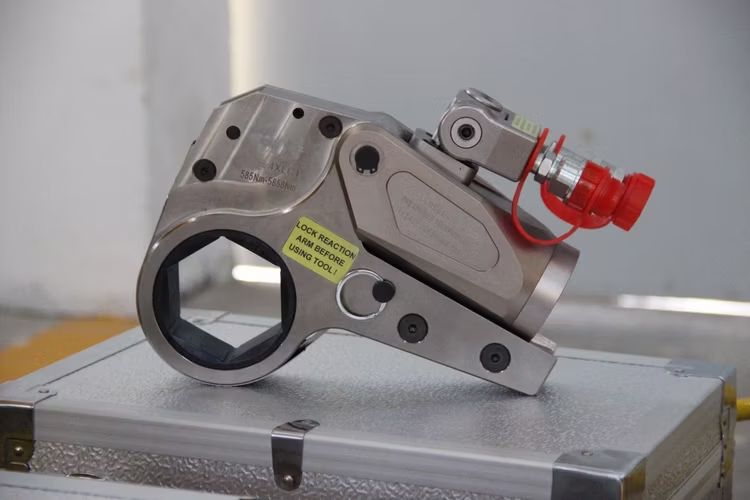
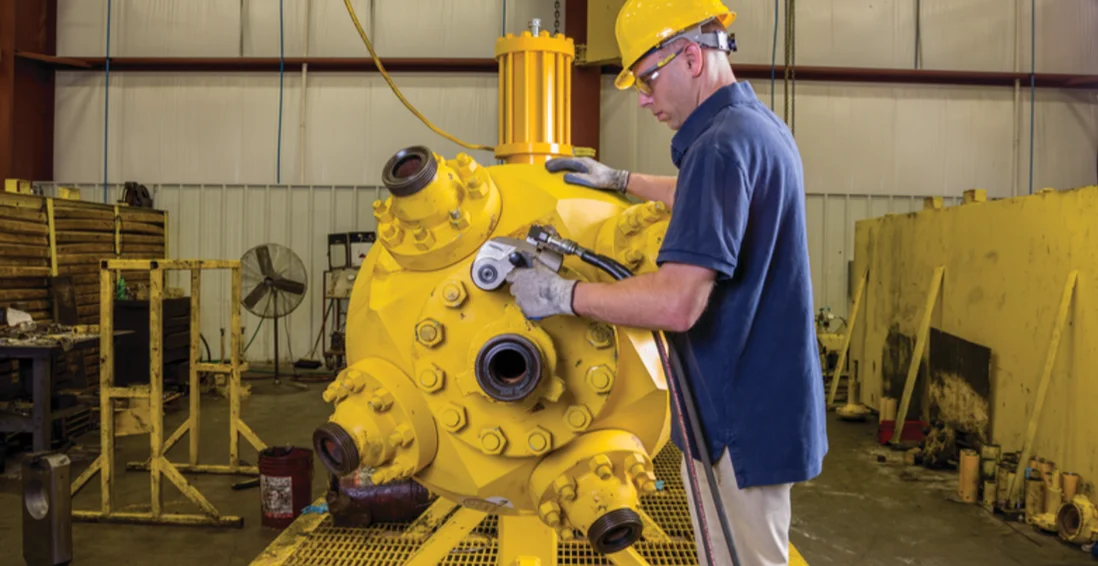
A hydraulic torque wrench gives UAE engineers and maintenance teams unmatched bolting precision — typically ±3% accuracy across a 200 to 70,000 Nm range. Because of this, they are indispensable for the UAE’s oil and gas infrastructure, Dubai high-rise foundations, and Abu Dhabi power plants.
Unlike impact guns (which carry ±20% variability) or manual tools (limited to around 1,000 Nm), hydraulic torque systems use controlled hydraulic pressure at 10,000 PSI to achieve ASME PCC-1 compliant bolt load. As a result, they prevent the flange leaks that cost operators millions of dirhams per day.
This complete 2026 guide covers square drive versus low-profile cassette specifications, full torque charts, ATEX Zone 1 compliance, and real-world Gulf applications — from ADNOC pipeline flanges to high-rise anchor bolts.
🔗 Browse Pluz Group’s full range of hydraulic torque wrenches — ATEX-certified and stocked for UAE delivery.
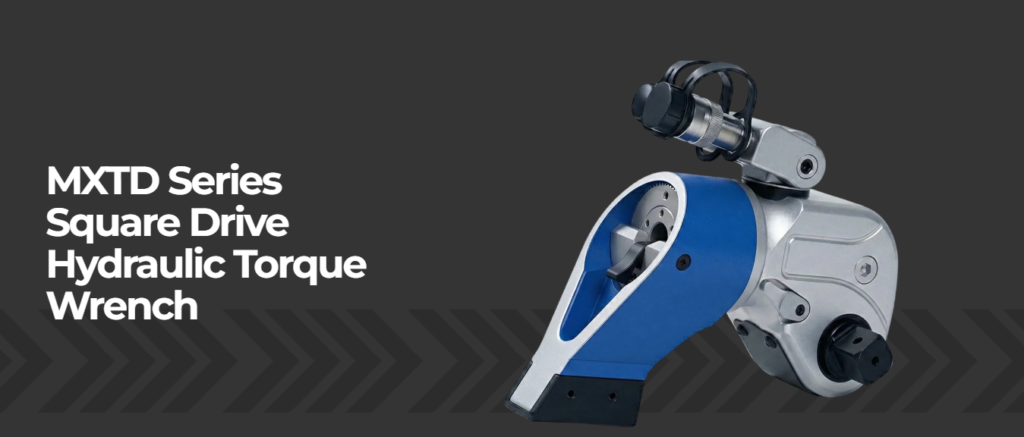
Chapter 1: How a Hydraulic Torque Wrench Works
The Precision Power Mechanism
A hydraulic torque wrench converts pressurised fluid into controlled rotation through Pascal’s Law — pressure applied anywhere in a sealed system transmits equally throughout. Here is the complete six-step operating cycle:
- Pump pressurisation — An electric (230V), pneumatic (8 bar), or battery pump builds 700–1,000 bar of pressure.
- Fluid delivery — Hoses rated to 10,000 PSI carry oil to the wrench cylinder without pressure loss.
- Piston stroke — A 15–32mm extension drives the spline shaft forward with mechanical advantage.
- Ratchet action — Heat-treated pawls engage the nut and rotate it 5–30° per stroke.
- Spring return — Pressure release retracts the piston, and the pawls slip idly backward.
- Controlled stall — Cycles repeat until the target pressure is reached, at which point the tool stops safely.
Physics formula: Torque (Nm) = Pressure (bar) × Cylinder Area (cm²) × Piston Radius (cm) × 0.94 Efficiency
Example: 700 bar × 20 cm² × 5 cm × 0.94 = 6,580 Nm delivered torque.
This mechanism achieves ±3% accuracy, compared with ±5–10% for pneumatic tools and ±20% for impact wrenches. In particular, that precision is critical for pressure vessel flanges where even 3% over- or under-torque can cause gasket failure.
UAE-Specific Engineering Demands
Standard hydraulic equipment struggles in Gulf conditions. Consequently, UAE operations require tools built specifically for the local environment.
Heat: At 50°C, standard hydraulic oil loses 15% of its viscosity. Therefore, ISO VG 46 oil is required for reliable performance.
Dust: 50-micron particles destroy seals three times faster in desert conditions than in cooler climates. As a result, proper seal selection and filtration are essential.
Salt corrosion: Gulf air demands nitrided cylinders rather than the standard chrome plating used in temperate markets.
ATEX hazardous area compliance:
- Zone 1 — Pneumatic pumps provide spark-free operation for areas where explosive atmospheres occur regularly.
- Zone 2 — Electric pumps with EEx d IIC T4 explosion-proof certification meet the standard for areas where explosive atmospheres are less likely.
- Offshore — IP68 ingress protection is mandatory for helideck and subsea-adjacent operations.
Chapter 2: Complete TSQ Series Specifications
Torque Specification Chart
The TSQ square drive series holds approximately 60% UAE market share. The table below provides the full specification range:
| Model | Torque Range (Nm) | Bolt Size | Drive Size | Weight (kg) | Stroke (mm) | Min Radius (mm) |
|---|---|---|---|---|---|---|
| TSQ-10 | 115–930 | M12–M20 | 1/2″ | 1.4 | 15 | 120 |
| TSQ-20 | 200–1,600 | M16–M24 | 3/4″ | 2.1 | 18 | 135 |
| TSQ-30 | 410–3,200 | M22–M30 | 1″ | 3.0 | 20 | 150 |
| TSQ-35 | 590–4,700 | M24–M36 | 1-1/2″ | 4.4 | 22 | 165 |
| TSQ-50 | 780–7,800 | M30–M42 | 1-1/2″ | 9.2 | 25 | 190 |
| TSQ-70 | 1,100–11,000 | M36–M48 | 2-1/2″ | 18.0 | 28 | 230 |
| TSQ-100 | 2,200–22,000 | M42–M64 | 2-1/2″ | 26.0 | 30 | 280 |
| TSQ-130 | 3,500–35,000 | M48–M72 | 2-1/2″ | 38.0 | 32 | 340 |
| TSQ-180 | 5,600–56,000 | M64–M90 | 2-1/2″ | 55.0 | 32 | 410 |
| TSQ-220 | 7,000–70,000 | M72–M100 | 2-1/2″ | 72.0 | 32 | 480 |
Most popular UAE models: TSQ-70 for pipelines, TSQ-100 for blowout preventers, TSQ-35 for turbine work.
Pressure-to-Torque Conversion: TSQ-70 Pipeline Standard
The TSQ-70 is the most widely used hydraulic torque wrench in UAE pipeline operations. Here is how pressure maps to torque output for common Gulf applications:
- 700 bar → 11,000 Nm — Suitable for 2-inch ANSI 900 flanges
- 600 bar → 9,400 Nm — Used for M48 wellhead studs
- 500 bar → 7,830 Nm — Covers 24-inch pipeline flanges
- 400 bar → 6,270 Nm — Applies to M42 heat exchanger connections
Safety rule: Always add a 15% margin to your calculated torque value to account for thermal expansion and gasket relaxation over time.
Chapter 3: Square Drive vs Low-Profile Cassette — Which Do You Need?
Choosing between a square drive and a low-profile cassette comes down to access, capacity, and how many different bolt sizes your team regularly works with.
TSQ Square Drive — Strengths and Limitations
Why UAE teams choose square drive:
- Universal 1/2-inch to 2-1/2-inch socket compatibility works with any fastener head
- Five-second tool changeover maximises productivity on large bolting campaigns
- Highest capacity reaches 70,000 Nm for M100 structural bolts
- A 360-degree adjustable reaction arm adapts to any flange geometry
Where square drive is less suitable:
- Requires 150–300mm of radial clearance around the bolt
- Needs a separate reaction point on an adjacent stud or structure
- Bulkier profile makes it harder to use inside confined vessel openings
Low-Profile Cassette — Strengths and Limitations
Why teams choose cassettes for tight access:
- Ultra-slim 4–6-inch height fits inside vessel skirts and manifold spaces
- Integrated nose reaction eliminates the need for an adjacent stud reaction point
- Lighter at 8–12 kg versus 18 kg for an equivalent square drive model
- Direct hex engagement prevents socket slippage under load
Where cassettes are less practical:
- Each cassette head covers only one specific bolt size
- Sixty-second link changeover slows transitions between sizes
- Maximum capacity is 45,000 Nm, compared with 70,000 Nm for square drive
Technical Comparison Table
| Specification | TSQ Square Drive | Low-Profile Cassette |
|---|---|---|
| Torque capacity | 200–70,000 Nm | 150–45,000 Nm |
| Minimum clearance | 150mm radius | 100mm radius |
| Reaction setup time | 30 seconds | 10 seconds |
| Tool change time | 5 seconds | 60 seconds |
| Weight (10,000 Nm model) | 18 kg | 10 kg |
| Cost AED (complete kit) | 32,000 | 25,000 |
| Versatility across bolt types | Excellent | Good (hex only) |
| UAE pipeline preference | 85% | 15% |
Quick selection guide:
- Clearance under 150mm? → Choose cassette
- Need over 45,000 Nm? → Square drive only
- Mixed flange geometries across a campaign? → Square drive versatility wins
Chapter 4: UAE Industry Applications
Oil and Gas Infrastructure — 65% of Market Demand
Pipeline Transmission Flanges
The Habshan-Fateh pipeline complex serves approximately 45% of UAE’s gas demand. Its 24-inch ANSI 900 flanges require 20 M64 bolts torqued to 25,000 Nm ±3%. In this application, the TSQ-100 delivers 22,000 Nm capacity with a 15% safety margin. Notably, hydraulic bolting on this system runs 45% faster than manual methods, and the 2025 season recorded zero leaks across all flanged joints.
BOP Quarterly Maintenance
API 16A 13-5/8-inch blowout preventers demand 16 M72 bonnet studs torqued precisely to 35,000 Nm. Furthermore, low-profile cassettes are mandatory here because inside-bonnet clearance is only six inches. A TSQ-130 with an ATEX pneumatic pump ensures full Zone 1 compliance throughout the procedure.
Offshore Platform Jackets
Offshore development projects in the region require M100 pile sleeve anchors torqued to 55,000 Nm under cyclic loading conditions. Consequently, the TSQ-180 with underwater-rated hoses is the specified tool for operations in wind speeds up to 40 knots.
Construction Mega-Projects — 25% of Market
High-Rise Foundation Anchors
UAE high-rise foundation specifications call for M120 rock anchors torqued to 50,000 Nm for seismic Zone 2B compliance. With 120 anchors per foundation mat and Dubai Municipality certification required for each, the TSQ-180 with triple-redundancy verification is the standard tool for this work.
Wind Tower Section Assembly
Wind energy projects in Ras Al Khaimah require M76 tower section flanges torqued to 28,000 Nm under continuous-duty conditions. On a typical project of eight towers with 48 bolts per tower, a TSQ-100 four-port manifold system completes 384 critical connections in 72 hours — compared with 10 days using manual methods.
Metro Infrastructure
Rail infrastructure gantry connections use M48 high-strength bolts torqued to the RTA’s 11,000 Nm specification. Moreover, the TSQ-70 meets the project requirement for night operations below 82 dB noise compliance.
Power Generation and Marine — 10% of Market
Gas Turbine Overhauls
Combined-cycle power plant H-Class combustion casings use M20 bolts requiring 1,200 Nm ±2% within OEM tolerance. With 480 bolts per turbine section, the TSQ-20 precision series completes this work efficiently. In addition, Siemens warranty terms require hydraulic verification records for every bolting operation.
Drydock Repairs
Rudder post installations in Dubai’s drydock operations require M90 propeller shaft nuts torqued to 42,000 Nm in submerged conditions. For this application, the TSQ-130 with extended stroke handles the tapered threads found on propeller shaft assemblies.
Chapter 5: UAE Procurement and ROI
2026 Pricing Guide (AED ex-VAT)
Basic tool packages:
- TSQ-70 wrench + 5m hose + analogue gauge: AED 18,500
- Low-profile 10,000 Nm cassette + pads: AED 22,000
Production kits:
- TSQ-70 full kit (electric pump + 8 sockets + manifold): AED 32,000
- Four-tool synchronised manifold system: AED 125,000
ATEX offshore packages:
- TSQ-100 Zone 1 complete (pneumatic pump + 20m hose): AED 48,000
- TSQ-180 submarine-rated full system: AED 180,000
Rental rates:
- Single tool, daily: AED 250–450
- Four-tool production package: AED 1,200 per day
- Weekly rates: 25% discount as standard
Investment ROI Example
Based on 1,000 production torque hours annually:
| Cost Item | Amount (AED) |
|---|---|
| Manual labour (85 AED/hr × 3 workers × 1,000 hrs) | 255,000 |
| Hydraulic system purchase | 120,000 |
| Annual maintenance | 8,000 |
| Net Year 1 saving | 127,000 |
| Payback period | 14 months |
As a general rule, eight or more major turnarounds annually justifies purchase over rental. Additionally, operations exceeding 50 torque hours per month will find ownership more cost-effective than ongoing rental.
🔗 Contact Pluz Group for a customised ROI calculation based on your specific turnaround schedule and bolt sizes.
Chapter 6: Maintenance in UAE Desert Conditions
Daily Procedures (5 minutes)
- Blow filtered compressed air at 90 PSI through the ratchet mechanism to clear dust
- Inspect hoses visually for abrasion or UV cracking along their full length
- Verify the pressure gauge returns to zero when the pump is switched off
Monthly Maintenance (30 minutes)
- Lubricate pawls with ISO VG 32 high-temperature grease
- Replace the pump oil filter cartridge
- Test the cylinder for external seepage — up to two drops per hour is within acceptable limits
Annual Certification (Full Day)
- ISO 6789-2 technical calibration to ±1% accuracy
- Complete seal kit replacement (approximately AED 2,500 in parts)
- 100-point torque verification across the full operating range
Desert-Specific Modifications
Standard equipment needs specific upgrades for UAE conditions. First, switch hydraulic oil to ISO VG 46 — this provides 15% higher viscosity protection in high heat. Second, use Viton 90 durometer seals, which resist both heat and chemical exposure far better than standard NBR seals. Third, specify 4-wire spiral hose construction rather than the 2-wire standard used in cooler climates.
Common failure prevention:
- Maintain a minimum 100mm bend radius on all hoses at all times
- Store tools below 35°C in climate-controlled containers between operations
- Complete an annual ATEX inspection for all Zone 1 electrical components
Chapter 7: Safety Protocols and Compliance
ADNOC Mandatory Requirements
ADNOC operations require operator certification through the API RP 2D bolting specialist course — a 40-hour programme. Furthermore, a 10-metre exclusion zone applies during all hydraulic torque wrench UAE operations. Required PPE includes a full face shield, cut-resistant gloves, and steel-toe boots with metatarsal guards.
Emergency Procedures
Hose burst: Shut down the pump immediately and evacuate to at least 15 metres from the work area.
Pressure relief failure: Activate the manual dump valve — identified by the red handle — to release system pressure safely.
Tool drop: A full disassembly and pressure test is required before the tool returns to service.
Reaction Force Management
The TSQ-70 generates approximately 8,000 kg of recoil force during operation. Consequently, the reaction arm must contact a solid, load-rated surface at all times. Never operate without a calibrated pressure gauge in view, and always verify that the reaction point can support 150% of the rated load before pressurising the system.
🔗 For full ADNOC bolting compliance requirements, refer to ASME PCC-1 Guidelines for Pressure Boundary Bolted Flange Joint Assembly and API RP 2D Operations and Maintenance of Offshore Cranes.
Chapter 8: Technology Trends for UAE Operations
The next generation of hydraulic torque tools is developing quickly. IoT torque logging with Bluetooth connectivity to cloud quality management platforms is already entering the market. In addition, 82V battery-hybrid pumps are set to eliminate generator dependency for offshore operations by 2027.
Carbon fibre wrench bodies are expected to reduce operating weight by 30% compared with current steel construction. Moreover, AI-driven predictive maintenance will alert operators to seal wear and gasket relaxation before failures occur — reducing unplanned downtime significantly.
Looking further ahead, autonomous bolting systems are in pilot development for brownfield maintenance operations. These platforms will integrate with digital twin models and blockchain-verified torque certificates for full asset integrity audit trails.
Buyer’s Checklist Before Purchase
Verify these points before committing:
- Torque capacity covers your largest bolt size plus a 20% safety margin
- ATEX Zone 1 certification is present for all oil and gas applications
- Local UAE supplier carries stock and can deliver within 24 hours
- Two-year warranty and a first-year calibration certificate are included
- Complete accessory kit is provided — sockets, hoses, and manifold ports
Procurement decision guide:
| Your Situation | Recommended Action |
|---|---|
| Single project under 30 days | Rent a complete system |
| Annual usage over 200 hours | Purchase a full kit |
| Mixed flange geometries | TSQ square drive for versatility |
| Confined vessel access | Low-profile cassette |
Get the Right Hydraulic Torque Wrench for Your UAE Operation
Pluz Group supplies complete hydraulic torque wrench solutions across the UAE — from single tool rentals to synchronised four-wrench production systems. All equipment is ATEX-certified, stocked locally, and supported by engineers with hands-on Gulf experience.
Whether you are bolting ADNOC pipeline flanges in Fujairah, maintaining blowout preventers in offshore Abu Dhabi, or assembling wind tower sections in Ras Al Khaimah, we have the tool, the specification, and the support to get the job done right.
👉 Contact Pluz Group today for ATEX-compliant packages, rental quotations, and technical consultation.